
Bridging the Know–Do Gap: IS4NCDs Intermediate Training Modules to Strengthen NCD Implementation in Africa
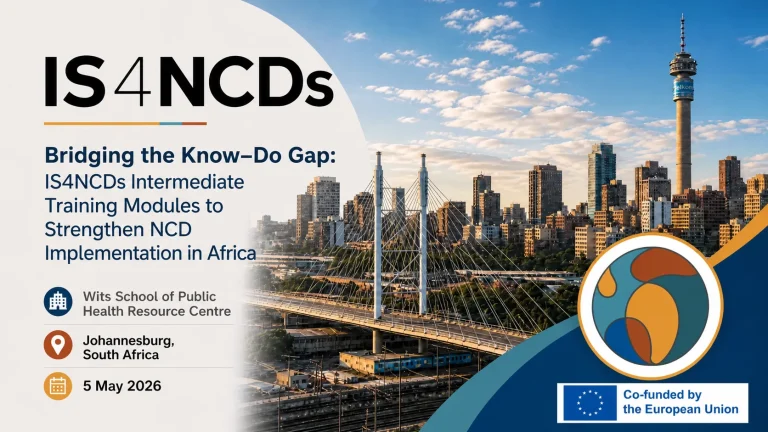
6 May 2006
The Implementation Science for Non-Communicable Diseases (IS4NCDs) Regional Consortium has taken a significant step forward in addressing the persistent gap between evidence and practice in NCD care across Africa. On day 2 of the IS4NCDs Regional Consortium Meeting held in Johannesburg, consortium members presented and discussed an Implementation Roadmap covering three new intermediate training modules designed to equip health workers, researchers, and programme implementers with the practical skills needed to improve NCD outcomes at scale.
The roadmap — developed collaboratively by Stellenbosch University (SUN), the University of the Witwatersrand (Wits), the University of Zambia (UNZA), and other consortium partners — was shared as a structured planning document outlining both the curriculum design and the institutional delivery plans for each module.
Why These Modules? The Implementation Gap in NCD Care
Despite the availability of clinical guidelines for the prevention, screening, diagnosis, and treatment of non-communicable diseases, outcomes remain suboptimal across Sub-Saharan Africa. The roadmap's introduction frames the core challenge clearly: the chronic nature of NCDs — often involving multimorbidity, sustained self-management, and repeated contacts with health systems — means that even small failures in care delivery accumulate over time and undermine patient outcomes.
The consortium identified that existing training in quality improvement (QI) and implementation science (IS) has largely been delivered in parallel, without meaningful integration. QI programmes tend to focus on practical improvement methods, while IS programmes emphasise conceptual frameworks and research design — leaving a gap in applied, executable capability that frontline implementers urgently need. Critically, none of the existing QI training offerings in the region were specifically tailored to the NCD implementation context.
This is the gap the new IS4NCDs intermediate modules are designed to fill.
Three Modules, One Integrated Vision
The Implementation Roadmap covers three interconnected intermediate modules, each targeting a distinct but complementary capability area:
1. Quality in Implementation Science (QI Module)
Led by Stellenbosch University, this five-day intensive module targets frontline health workers and mid-level staff involved in QI initiatives. Participants work through the full arc of a quality improvement project — from problem identification and root cause analysis, to designing PDSA cycles and measuring outcomes — with explicit application to NCD service delivery.
The curriculum draws on major frameworks including the Model for Improvement (IHI), Lean, Six Sigma, and the Donabedian Model, while also engaging with South Africa's National Core Standards, Ideal Clinics Programme, and WHO's PEN and HEARTS technical packages. A notable feature is its use of Challenge-Based Learning (CBL), in which interdisciplinary participant groups identify a real-world NCD health systems gap on Day 1 and develop a full QI project proposal by Day 5 — assessed through a combination of presentations, group work, and an individual written component.
The module was developed building on Stellenbosch University's existing postgraduate QI offering, with additional input from QI experts at Wits and a structured review of offerings from UNISA, Harvard, the IHI Open School, and other institutions.
2. Mixed Methods Research in Implementation Science (MM Module)
This semester-long module (13 weeks, 10 credits) is designed for postgraduate students, early-career researchers, and NGO/government staff involved in NCD programme evaluation. Delivered in a hybrid format, it equips learners to design, conduct, and critically appraise mixed methods studies within an implementation science framework.
The rationale is compelling: implementation challenges in NCD care rarely have single-cause explanations. Quantitative data can reveal where gaps exist — in treatment initiation, retention, or disease control rates — but qualitative inquiry is needed to explain why those gaps persist. Together, mixed methods approaches strengthen causal inference, improve strategy tailoring, and enable more robust implementation evaluations.
The module covers core designs (convergent parallel, explanatory sequential, exploratory sequential, embedded, and multiphase), with a strong emphasis on integration — the defining feature that distinguishes genuine mixed methods research from simply running parallel studies. Assessment centres on a group-developed mixed methods research proposal addressing a locally relevant NCD problem.
The curriculum was benchmarked against offerings from the University of Toronto, UC San Diego, University of Southampton, and the University of Florida, while being adapted for the realities of low- and middle-income country research training.
3. Participatory Action Research in Implementation Science (PAR Module)
Coordinated by Stellenbosch University's Prof Lynn Hendricks, this 12-credit, semester-long module makes the case that effective NCD implementation depends on genuine co-creation with those who deliver and receive care — patients, communities, frontline providers, and health managers.
The PAR module covers the philosophical foundations of participatory research, community-based participatory research (CBPR), co-design methodologies, stakeholder mapping, ethics and reflexivity, and the design of participatory implementation studies. It is grounded in African health system realities and draws on a structured review of more than 20 international programmes offering participatory research training, from the University of KwaZulu-Natal and Rhodes University to Johns Hopkins, Uppsala, and Erasmus Rotterdam.
A key finding from the consortium's formative review was that while strong global content exists on participatory research and on implementation science, few curricula bring both strands together in a way that is explicitly oriented toward NCD implementation in African contexts. This module directly responds to that gap.
Designed for Sustainability and Scale
A consistent thread across all three modules is attention to long-term sustainability. Each is designed for integration as a credit-bearing elective within existing postgraduate programmes, reducing dependence on standalone short-course funding. Annual curriculum reviews, participant feedback mechanisms, and internal and external moderation processes are all built into the institutional delivery plans.
The modules will be hosted on the IS4NCD Wits online hub (QI module) and SunLearn/Ulwazi (PAR and MM modules), ensuring accessible, scalable delivery across the consortium's partner institutions.
A Roadmap With Regional Ambition
The fact that this roadmap was developed collectively — and presented at the IS4NCDs Regional Consortium Meeting in Johannesburg for cross-institutional input and alignment — reflects the programme's broader ambition. IS4NCDs is not building capacity at one institution; it is building a regional ecosystem of implementation scientists and improvement practitioners who share frameworks, tools, and a commitment to evidence-based NCD care.
For higher education institutions in the region, the programme offers curriculum innovation aligned with national priorities for chronic disease control and universal health coverage. For health systems, it promises graduates who are not only conceptually equipped but operationally ready — able to reduce variation in care, strengthen referral systems, embed continuous measurement into routine services, and carry the evidence-to-practice work forward with communities rather than at a distance from them.
The IS4NCDs Implementation Roadmap is a detailed, actionable document. But more than that, it is a signal of what becomes possible when academic institutions, health systems, and implementation science communities work together with a shared purpose: better NCD outcomes for populations who can least afford the consequences of the know–do gap.


The IS4NCDs project has received funding from the European Union's Erasmus+ programme under Grant Agreement no. 101179511
The IS4NCDs project has received funding from the European Union's Erasmus+ programme under Grant Agreement no. 101179511