
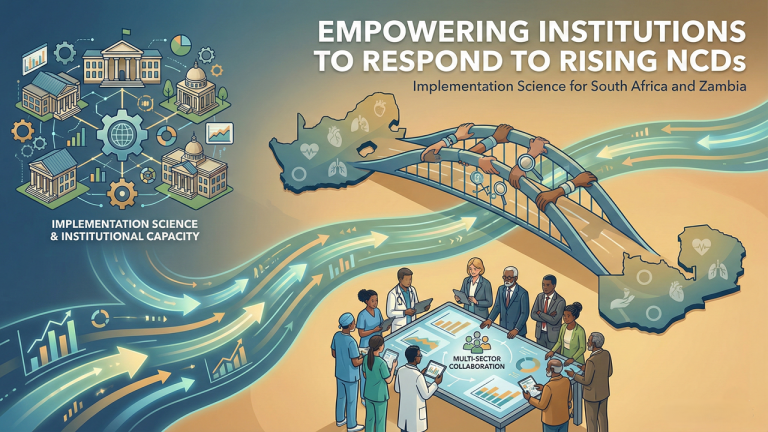
Empowering Institutions to Respond to Rising NCDs: Implementation Science for South Africa and Zambia
22 November 2025
Noncommunicable diseases (NCDs) present an urgent and growing health challenge across sub-Saharan Africa, including South Africa and Zambia. According to an analysis of the Global Burden of Disease Study 2023, recently published in The Lancet, NCDs are now responsible for nearly two-thirds of global disability-adjusted life years (DALYs), with ischaemic heart disease, stroke, diabetes, and chronic respiratory diseases as leading contributors. In Southern Africa, this burden is compounded by rapid urbanisation, economic and social transitions, and persistent inequities, placing immense strain on public health systems.
In South Africa, the percentage of deaths due to NCDs increased from 24.2% in 2000 to 49.6% in 2023; this equates to 1 out of every 2 deaths in South Africa due to an NCD.. Significantly, 54% of NCD deaths occur in those aged less than 70 years, indicating a high rate of premature mortality . Despite national strategies and policies, such as the National Strategic Plan for the Prevention and Control of NCDs 2020–2025, implementation is challenging due to a complex interaction of competing priorities, insufficient access to essential medicines, health workforce challenges, and infrastructure gaps, amongst others.
In Zambia, nearly 40% of all deaths can be attributed to NCDs, of which nearly three quarters are premature. Diabetes, cardiovascular disease, chronic respiratory conditions, and cancers dominate disease patterns. The 2017 WHO STEPS survey identified three distinct risk groups within the Zambian population: Low-Risk (12%), Intermediate-Risk (64%), and High-Risk (24%), placing nearly 88% of the population at immediate or high risk for NCDs. This is expected to further strain the health system and resources, and pose higher economic burden. Zambia’s National Health Strategic Plan (2022–2026) aims to reduce NCD-driven mortality by strengthening prevention, multi-sector collaboration, and primary care capacity, recognising the need for a holistic approach to tackle the burden of NCDs.
Implementation Science: The Pathway to Sustainable Progress
Many risk factors could be mitigated through effective and sustainable implementation of contextual solutions. The 2023 global burden of disease study highlights that 88 modifiable risk factors - including blood pressure, diet, tobacco use, and air pollution - are responsible for a significant portion of the NCD burden. Adapting global evidence into local practice, with robust monitoring and catalysed by a multi-sector approach, can strongly contribute in achieving more sustainable progress Implementation science and research offers a methodological paradigm for this translation, supporting professionals along the implementation pathway through theory, models, frameworks, rigorous appraisal of context in relation to implementation outcomes, and monitoring and evaluation of the implementation-effectiveness of implementation strategies, amongst others.
Strengthening Institutional Capacity
IS4NCDs, a consortium led by universities in South Africa, Zambia, and Europe, targets the urgent need to develop skilled health, education, and research teams in implementation science; to strengthen the capacity for navigating change in the very professionals that are responsible for implementing innovation within their setting and across the (health) system IS4NCDs’ competency-based modules and including an executive implementation science course, created in collaboration with local stakeholders, will prepare professionals to lead change from the clinic to the policy level. The programmes will build capacity in integrating and sustaining NCD prevention and care strategies into broader health systems and educational institutions.


The IS4NCDs project has received funding from the European Union's Erasmus+ programme under Grant Agreement no. 101179511
The IS4NCDs project has received funding from the European Union's Erasmus+ programme under Grant Agreement no. 101179511