
Exploring Global Challenges in Non-Communicable Diseases: Insights from the 2025 Utrecht Summer School
16 July 2025
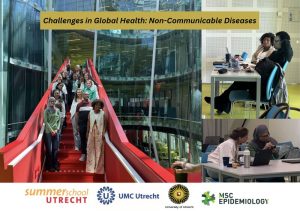
The 2025 "Challenges in Global Health: Non-Communicable Diseases" summer school, held from July 7 to July 11 at the University Medical Centre Utrecht, offered a comprehensive and interactive learning experience focused on addressing the global impact of non-communicable diseases (NCDs). Coordinated by Prof. Kerstin Klipstein-Grobusch, the course brought together participants and experts from Europe, Africa, Asia, and South America, including members of IS4NCDs and the Capstone West Africa consortium, to explore critical issues surrounding NCDs in diverse global settings.
Course Highlights and Objectives
Over the intensive one-week program, participants examined the burden and risk factors associated with NCDs, the influence of early life environments, and the complex interplay between communicable and non-communicable diseases. The curriculum also addressed the effects of globalization, migration, climate change, and environmental factors on health outcomes. Key discussions focused on effective prevention, management strategies across different health systems, and innovative policy responses, including the application of e-health, m-health, and big data technologies.
By the conclusion of the course, participants had enhanced their ability to:
- Describe the epidemiology and global burden of NCDs.
- Explain how early life experiences contribute to disease variation.
- Analyze the intersection between communicable and non-communicable diseases.
- Assess how global health threats influence NCD prevention and control.
- Apply principles of disease surveillance, control, and prevention in various contexts.
Expert Faculty and Collaboration
The summer school was part of Utrecht University’s MSc Epidemiology program and organized through the UMC Utrecht's Global Health initiative. It featured an international and interdisciplinary faculty renowned for their expertise in global health and NCDs, including:
- Assoc. Prof. Dr. Regien Biesma (UMC Utrecht)
- Dr. Daniel Boateng (Kwame Nkrumah University of Science and Technology, Ghana & UMC Utrecht)
- Dr. Olga Cambaco (Universidade Eduardo Mondlane, Mozambique)
- Dr. George Downward (UMC Utrecht)
- Dr. Grace Marie V. Ku (Institute of Tropical Medicine, Belgium)
- Assoc. Prof. Dr. Ana Mocumbi (Universidade Eduardo Mondlane, Mozambique)
- Dr. Daniel Opoku (Technical University Berlin & Kwame Nkrumah University, Ghana)
- Prof. Dr. Monique Verschuren (UMC Utrecht)
These experts facilitated rich discussions and fostered cross-cultural academic exchange.
Participants and Impact
The course was open to master's students and professionals from epidemiology, public health, medicine, biomedical, and social sciences backgrounds with an interest in global health and NCD challenges. Through interactive sessions and collaborative learning, participants gained a deeper understanding of the varied challenges faced by low-, middle-, and high-income countries in managing NCDs.
Future Directions
Following this successful 2025 session, the Global Health Summer Schools at Utrecht continue with courses on Implementation Sciences in Global Health, Global Health Ethics & Equity, and Planetary Health. Preparations are underway for the 2026 edition, continuing to provide interdisciplinary education on urgent global health issues.


The IS4NCDs project has received funding from the European Union's Erasmus+ programme under Grant Agreement no. 101179511
The IS4NCDs project has received funding from the European Union's Erasmus+ programme under Grant Agreement no. 101179511