
Fidelity Drift: The Silent Reason Programmes Stop Working at Scale
13 July 2026
A district rolls out a new hypertension protocol. The training is done, the job aids are printed, everyone signs off. Six months later, an audit turns up something quiet but troubling: most nurses are still measuring blood pressure the old way — wrong cuff size, no rest period beforehand, a single reading instead of two.
Nobody decided to ignore the new protocol. Nobody was told to stop following it. It simply drifted.
How an Established Protocol Quietly Becomes a Different One
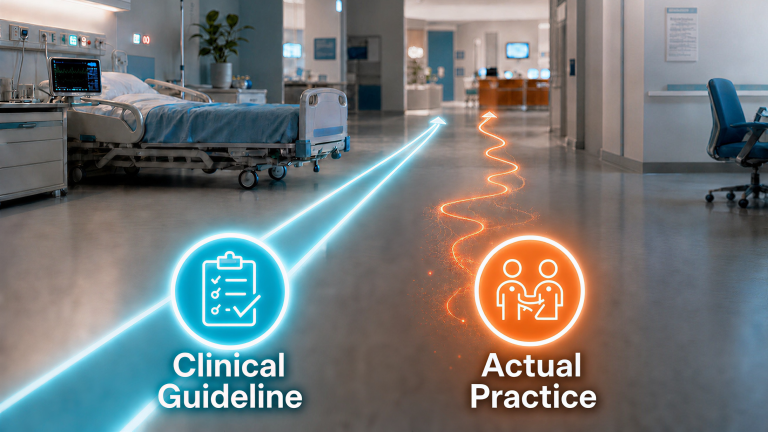
Implementation science calls this fidelity drift — the gradual, often unnoticed gap between how a programme is designed to be delivered and how it actually plays out in daily practice. It rarely happens through one bad decision. It accumulates through small workarounds under time pressure, staff turnover that loses the original training, and informal shortcuts that nobody flags because each one, on its own, seems minor.
For chronic, multi-step NCD protocols — hypertension algorithms, diabetes screening pathways, cervical cancer screen-and-treat programmes — there are far more opportunities for drift than in a single, one-time intervention. This is one of the most common reasons a programme that performed well in a pilot fails to reproduce those results once it scales into routine care.
Broken Programme or Broken Delivery? Why You're Probably Diagnosing Failure Wrong
When a programme “isn’t working,” it’s tempting to conclude the intervention itself is flawed, or that staff aren’t trying hard enough. Implementation science pushes back on both assumptions. Often, the intervention is sound and the staff are trying; the actual delivery has simply moved away from what was designed, one small adjustment at a time. Telling these apart matters, because the fix is completely different depending on which one you’re facing: retaining staff on a protocol they’ve forgotten looks nothing like redesigning a protocol that never fit local conditions in the first place.
Adaptation vs. Erosion: Where Local Flexibility Ends
None of this means every local adjustment is a problem. Implementation science recognises that some adaptation to local context is not only expected but often necessary and beneficial. The distinction that matters is between adapting how something is delivered — language, timing, format — and quietly losing the active components that make the intervention work in the first place, such as skipping a required step or reducing dosage frequency without any clinical rationale.
Recognising where that line sits, in a specific programme, is a skill, one built through structured attention to what’s actually happening in daily practice, not assumption.
From Hindsight to Habit: Catching Drift Before It Costs You
Noticing fidelity drift isn’t about assigning blame. It’s often the first clue that something in the surrounding system — supply, staffing, workflow, training refresh cycles — needs attention.
But recognising drift in a story like the one above, after the fact, is a different skill from catching it early and reliably in your own facility, before it quietly undoes months of work. Building that ongoing, working method, one that also tells drift apart from a design flaw that needs a different fix entirely, is exactly the kind of applied capability that the IS4NCDs training tracks are being built to develop, at a level matched to where you sit in the health system, from frontline practice through to policy.


The IS4NCDs project has received funding from the European Union's Erasmus+ programme under Grant Agreement no. 101179511
The IS4NCDs project has received funding from the European Union's Erasmus+ programme under Grant Agreement no. 101179511