
IS4NCDs Presents Insights on Implementation Science and Practice at IMPACT 2026
17 February 2026
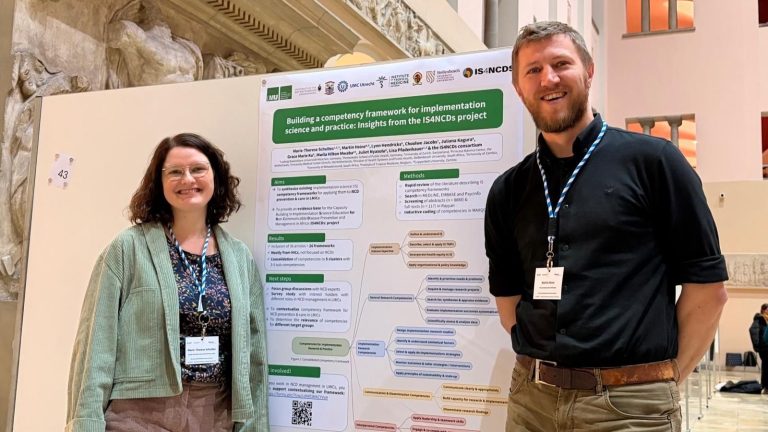
The IS4NCDs consortium shared insights on strengthening implementation science capacity at the 4th Swiss Implementation Science Conference “True IMPACT – Providing Innovation for Patients and the Public”, held on 12–13 February 2026 at the University of Zurich. At a well‑attended poster presentation, Marie‑Therese Schultes and Martin Heine invited delegates to discuss 26 unique competency frameworks for implementation science and practice.
Poster Highlights: 26 Frameworks, One Shared Goal
The poster showcased how diverse competency frameworks describe what implementation scientists and practitioners should know and be able to do. The work identified 26 frameworks and consolidated their competencies into five clusters and three sub‑competence domains, capturing areas such as theoretical and methodological knowledge, stakeholder engagement, contextual adaptation, and evaluation of implementation processes and outcomes.
From Competency Framework to Real‑World Capacity
The IS4NCDs consortium is co‑developing new modules, an executive course, and an open eHub that draw on these synthesised competencies while adapting them to regional health system priorities and resource constraints.
This work supports the broader goal of IS4NCDs: strengthening institutional capacity so that health professionals, educators, and researchers are equipped to translate evidence and NCD policies into sustainable practice.
Engagement and Next Steps After IMPACT 2026
Throughout the conference, Schultes and Heine used the poster as a conversation starter with researchers, practitioners, and policy‑makers interested in clarifying and benchmarking implementation science competencies. Discussions touched on how the synthesised frameworks could be applied in different health systems, and where additional work is needed to reflect the realities of low‑ and middle‑income countries and NCD‑focused implementation efforts.
Following IMPACT 2026, the IS4NCDs consortium will continue with the development of its competency‑based modules and executive course, and share emerging lessons through its training and engagement platforms.


The IS4NCDs project has received funding from the European Union's Erasmus+ programme under Grant Agreement no. 101179511
The IS4NCDs project has received funding from the European Union's Erasmus+ programme under Grant Agreement no. 101179511