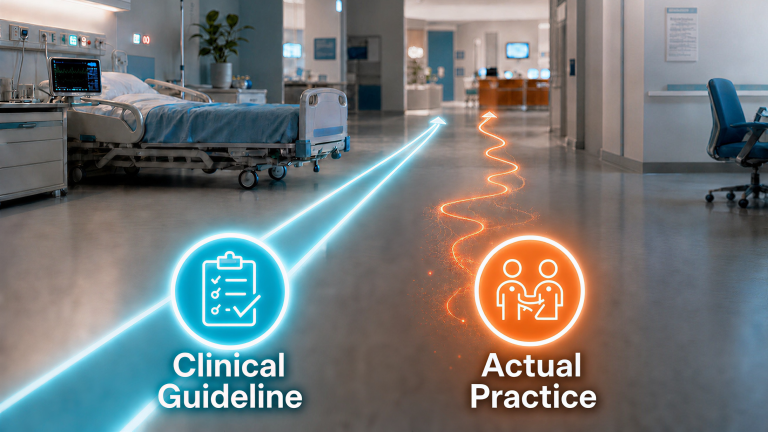
The Know-Do Gap: Why Good Evidence Alone Does Not Change What Happens in the Clinic

The Know-Do Gap: Why Good Evidence Alone Does Not Change What Happens in the Clinic

The Know-Do Gap: Why Good Evidence Alone Does Not Change What Happens in the Clinic

6 August 2026

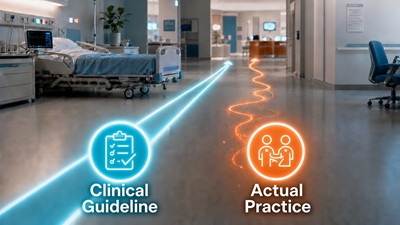
A national hypertension guideline is published, endorsed and distributed to every facility in a province. The evidence behind it is not in question — it is drawn from large trials. Reviewed by experts and consistent with World Health Organization recommendations. Eighteen months later, an audit finds that barely a third of eligible patients are being managed according to it.

Nothing was wrong with the evidence. The guideline simply never closed the distance between what is known and what is done.

The Gap That Evidence Alone Cannot Close

Implementation science calls this the know-do gap — the persistent space between what research has established works and what actually happens in routine care. It is not a knowledge problem in the way it first appears. Most clinicians in the audit above were aware the guideline existed. Awareness was never the barrier.

The gap opens for reasons that have little to do with the strength of the evidence itself: a workflow that assumes staffing the guideline’s authors never accounted for, a supply chain that cannot sustain the recommended medication combination, or a patient population whose circumstances the original trial never captured.

Efficacy Is Not the Same Question as Implementation

Much of the confusion around the know-do gap comes from treating ‘does it work’ and ‘will it work here, delivered by this workforce, under the conditions’ as the same question. They are not. Efficacy research asks whether an intervention produces the intended effect under controlled or ideal conditions. Implementation research asks something else entirely: whether, and how, the same intervention can be delivered reliably under real, resource-variable conditions of routine care.

A guideline can be extremely well evidenced on the first question and still fail completely on the second — and in low- and middle- income health systems, where the gap between ideal and routine conditions is often widest, this distinction tends to matter more, not less.

Why the Gap Persists Longer in NCD Care

For a single-encounter intervention, the know-do gap is a one-off hurdle: either the intervention is delivered on that occasion or it is not. NCD management rarely works that way. A hypertension or diabetes protocol has to be delivered consistently, visit after visit, for years, across a health workforce that turns over and a supply chain that fluctuates. Every one of those repeat encounters is a fresh opportunity for the gap to reopen, even after it has apparently been closed.

Closing the Gap is a Distinct, Learnable Skill

Recognising that a know-do gap exists in one’s own setting is a reasonable starting point. Diagnosing why it exists in a specific facility or programme — separating a workflow mismatch from a resourcing shortfall because of a training deficit, and knowing which levers actually close each kind — is a distinct and considerably harder skill. Building that capability, calibrated to one’s position in the health system, is central to what the IS4NCDs training pathway is designed to do.

The IS4NCDs project has received funding from the European Union's Erasmus+ programme under Grant Agreement no. 101179511
The IS4NCDs project has received funding from the European Union's Erasmus+ programme under Grant Agreement no. 101179511
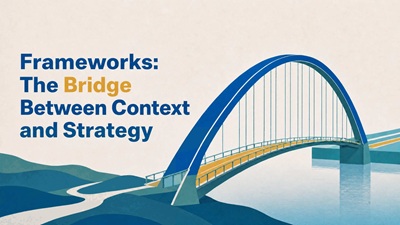
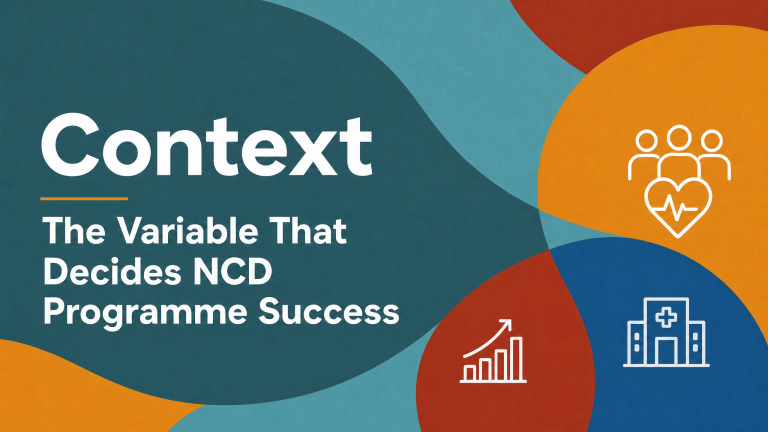
Context: The Variable That Decides NCD Programme Success

Context: The Variable That Decides NCD Programme Success

Context: The Variable That Decides NCD Programme Success

4 August 2026

When an NCD programme succeeds in one facility and stalls in another — despite using an identical protocol, identical training, and an identical evidence base — the cause is rarely a flaw in the intervention. It is almost always context: the surrounding conditions, inside and outside the facility, that a programme is dropped into. Context can be assessed systematically before rollout; when it isn't, the mismatch tends to surface only after the programme has already stalled.

Two Clinics, One Protocol, Two Different Results

A cervical cancer screen-and-treat programme launches across a region. In an urban clinic, uptake climbs steadily and holds. In a rural facility thirty kilometres away, running the identical protocol with the identical training, uptake barely moves before stalling out entirely.

Nothing about the intervention changed between the two sites. What differed was the context each was operating in.

Inner Setting and Outer Setting: The Two Layers That Make Up Context

Implementation science splits context into two critical layers:

  • The Inner Setting: What is happening inside the facility itself — leadership support, staffing levels, workflow, culture, and available resources.
  • The Outer Setting: What surrounds the facility — the policy environment, funding cycles, supply chains, referral networks, and community norms.

A programme can be well-designed and well-delivered and still fail purely because one or both of these layers was not accounted for. A well-staffed urban clinic with a reliable supply chain and an engaged facility lead offers a fundamentally different context than a single-nurse rural facility managing intermittent stock-outs — even when both are nominally running "the same programme."

NCD Care is Especially Exposed to Context, Because It Depends on It Holding Steady

Unlike a one-time intervention, NCD management is ongoing and heavily relies on long-term systemic stability:

  • Repeat patient visits over years rather than days
  • Continuous medication supply without interruption
  • Functioning referral pathways across different tiers of care
  • Consistent patient follow-up mechanisms

Each of these depends on context holding steady over a long period, which gives local conditions far more opportunity to make or break an NCD programme than they would a single-encounter intervention.

Structured Assessment, Not General Familiarity, is What Implementation Science Adds

Most health professionals already know that local conditions vary from one facility to the next — that observation alone isn't the insight. What implementation science adds is a structured way to assess which specific contextual factors are likely to matter, systematically, before rollout.

Frameworks used in the field — the Consolidated Framework for Implementation Research (CFIR) among them — break context down into specific, checkable domains:

  • Leadership engagement and strategic buy-in
  • Compatibility with existing clinical workflows
  • Communication networks and information flow
  • Resource availability and infrastructure capacity

That specificity is what turns a vague intuition into something a team can actually plan around.

Local Control Versus Escalation: Knowing Which Barriers are Actually Yours To Fix

Not every contextual barrier sits within local control. Part of working effectively with context is distinguishing what can be addressed locally from what needs to be escalated:

  • Local Control: Adjusting daily workflows, strengthening internal team communication, or identifying a local clinical champion.
  • System Escalation: Resolving national or regional supply chain issues, structural funding gaps, or broad policy limitations.

Directing effort accordingly ensures teams do not ignore system-level barriers or exhaust local capacity trying to fix something structural.

A Capability IS4NCDs Will Equip You With: Assessing Context Before Rollout, Not After

Understanding, in hindsight, why one clinic succeeded and another stalled is a useful starting point. Systematically assessing your own facility's context before rollout — and knowing which barriers are yours to fix locally versus which need to be escalated — is a distinct, learnable skill. It is a key capability that IS4NCDs training is designed to build, at a level suited to your position in the health system.

The IS4NCDs project has received funding from the European Union's Erasmus+ programme under Grant Agreement no. 101179511
The IS4NCDs project has received funding from the European Union's Erasmus+ programme under Grant Agreement no. 101179511

Implementation Strategies: The Deliberate Choice That Decides Whether an NCD Programme Survives

Implementation Strategies: The Deliberate Choice That Decides Whether an NCD Programme Survives

Implementation Strategies: The Deliberate Choice That Decides Whether an NCD Programme Survives

23 July 2026

When an NCD programme underperforms, the clinical evidence is rarely the problem. The deciding factor is almost always the implementation strategy — the deliberate method used to support a protocol's adoption, delivery, and sustainment, distinct from the clinical intervention itself. Training, audit-and-feedback, local champions, task-shifting, workflow redesign, and financial incentives are all examples. Programmes that diagnose their specific barrier and match a strategy to it tend to survive past the pilot stage; programmes that default to generic training regardless of the barrier tend to fade once initial momentum runs out.

That single distinction — matched strategy versus generic response — is usually what separates an NCD programme that sticks from one that quietly reverts to baseline.

Two Districts, One Protocol, Two Different Outcomes

Two districts roll out the same diabetes screening protocol, built on the same evidence, using the same forms and training materials. District A trains staff once and moves on; eighteen months later, screening rates have slid back to where they started.

District B adds a monthly supervisor check-in, adjusts its forms after frontline staff flag a problem in week two, and installs a local champion in each clinic; eighteen months later, screening hasn't just held, it has spread on its own to three neighbouring facilities.

Same evidence, same forms — different implementation strategy, different outcome.

Training Alone Rarely Fixes a Struggling Programme

Training is the default response when a programme underperforms, and it's not the wrong instinct — it's simply the weakest one when used alone, especially when the actual barrier has nothing to do with knowledge. A workflow that doesn't fit how a clinic operates, a supply chain that can't sustain the intervention, or a lack of leadership buy-in won't be solved by another workshop.

The stronger, better-evidenced approach is to diagnose the specific barrier first, then select — or combine — strategies matched to it. Two or three well-chosen strategies together consistently outperform either a single generic one or an overcomplicated bundle assembled without a clear rationale.

NCD Care Depends on Consistent Delivery, Not Just Proven Evidence

Much of the evidence base for NCD prevention and management is already strong: WHO PEN protocols, the HEARTS technical package, established screening guidelines. The recurring bottleneck across health systems is rarely "does this intervention work" — it's "how do we get it delivered consistently, at scale, under real conditions." That is precisely the gap implementation strategies exist to close, and precisely why the same protocol can succeed in one district and fail in the next.

Cost is Not the Same as Complexity

A common concern is that implementation strategies sound resource-intensive. Many aren't: a peer champion drawn from existing staff, an audit-and-feedback loop built from data the facility already collects, or a small workflow adjustment are all legitimate, low-cost strategies. The skill isn't budget — it's deliberate matching, and most experienced health workers are already running informal versions of this without naming it (a senior nurse mentoring a newer colleague is, functionally, running a champion strategy).

The Capability IS4NCDs Will Equip You With: Diagnosing Barriers and Matching Strategies

Reading a comparison like the one above and recognising, in hindsight, that District B chose better is a reasonable starting point. Diagnosing a barrier correctly and matching a strategy to it — in your own setting, before months of staff time and budget are already committed — is a distinct and considerably harder skill. Building that capability, calibrated to your role in the system, is what IS4NCDs' training pathway is designed to do.

The IS4NCDs project has received funding from the European Union's Erasmus+ programme under Grant Agreement no. 101179511

The IS4NCDs project has received funding from the European Union's Erasmus+ programme under Grant Agreement no. 101179511

Fidelity Drift: The Silent Reason Programmes Stop Working at Scale

Fidelity Drift: The Silent Reason Programmes Stop Working at Scale

Fidelity Drift: The Silent Reason Programmes Stop Working at Scale

13 July 2026

A district rolls out a new hypertension protocol. The training is done, the job aids are printed, everyone signs off. Six months later, an audit turns up something quiet but troubling: most nurses are still measuring blood pressure the old way — wrong cuff size, no rest period beforehand, a single reading instead of two.

Nobody decided to ignore the new protocol. Nobody was told to stop following it. It simply drifted.

How an Established Protocol Quietly Becomes a Different One

Implementation science calls this fidelity drift — the gradual, often unnoticed gap between how a programme is designed to be delivered and how it actually plays out in daily practice. It rarely happens through one bad decision. It accumulates through small workarounds under time pressure, staff turnover that loses the original training, and informal shortcuts that nobody flags because each one, on its own, seems minor.

For chronic, multi-step NCD protocols — hypertension algorithms, diabetes screening pathways, cervical cancer screen-and-treat programmes — there are far more opportunities for drift than in a single, one-time intervention. This is one of the most common reasons a programme that performed well in a pilot fails to reproduce those results once it scales into routine care.

Broken Programme or Broken Delivery? Why You're Probably Diagnosing Failure Wrong

When a programme “isn’t working,” it’s tempting to conclude the intervention itself is flawed, or that staff aren’t trying hard enough. Implementation science pushes back on both assumptions. Often, the intervention is sound and the staff are trying; the actual delivery has simply moved away from what was designed, one small adjustment at a time. Telling these apart matters, because the fix is completely different depending on which one you’re facing: retaining staff on a protocol they’ve forgotten looks nothing like redesigning a protocol that never fit local conditions in the first place.

Adaptation vs. Erosion: Where Local Flexibility Ends

None of this means every local adjustment is a problem. Implementation science recognises that some adaptation to local context is not only expected but often necessary and beneficial. The distinction that matters is between adapting how something is delivered — language, timing, format — and quietly losing the active components that make the intervention work in the first place, such as skipping a required step or reducing dosage frequency without any clinical rationale.

Recognising where that line sits, in a specific programme, is a skill, one built through structured attention to what’s actually happening in daily practice, not assumption.

From Hindsight to Habit: Catching Drift Before It Costs You

Noticing fidelity drift isn’t about assigning blame. It’s often the first clue that something in the surrounding system — supply, staffing, workflow, training refresh cycles — needs attention.

But recognising drift in a story like the one above, after the fact, is a different skill from catching it early and reliably in your own facility, before it quietly undoes months of work. Building that ongoing, working method, one that also tells drift apart from a design flaw that needs a different fix entirely, is exactly the kind of applied capability that the IS4NCDs training tracks are being built to develop, at a level matched to where you sit in the health system, from frontline practice through to policy.

The IS4NCDs project has received funding from the European Union's Erasmus+ programme under Grant Agreement no. 101179511
The IS4NCDs project has received funding from the European Union's Erasmus+ programme under Grant Agreement no. 101179511