7 May 2026
The third day of the IS4NCDs Regional Consortium Meeting brought together academics, researchers, health professionals, and knowledge creation teams from across Southern Africa and beyond for another productive session. With key curriculum decisions already made on Day 2, the group turned its energy toward the substance of advanced module design, an ambitious executive course concept, and the pedagogical principles that will underpin the entire training programme.
Reflecting on Progress: Decisions That Lifted the Weight
The day opened with a recap of the week's milestones. The facilitator noted with evident relief that the group had successfully resolved some of the most consequential questions facing the project: where the pilot modules would be offered, for which audiences, in what format, and on what timelines.
The agreed approach is to offer core modules as workshops — designed to the rigour of a short course but delivered in workshop format across four participating institutions simultaneously. This model allows the consortium to pilot effectively within the project's timeframe while the formal accreditation processes run in parallel. Synchronous virtual lectures, streamed live into all four institutional venues, will ensure consistency of delivery while capping on-site attendance at each location.
Intermediate modules are being positioned for formal short course accreditation before their pilot, with particular strategic importance for Stellenbosch University, where the modules are expected to catalyse an implementation science programme that has been approved but not yet fully executed. Advanced modules will be offered initially as workshops, similarly designed as short courses, with a view to longer-term integration into existing academic programmes.
Advanced Modules Take Shape
Much of the morning was devoted to presentations and discussion of the three advanced modules under development.
Health Economics in the Implementation of Health Programmes
The first advanced module addresses a recognised gap: while many practitioners working in the NCD space may have some exposure to health economics, few have engaged with how economic thinking applies specifically during the implementation process. The module aims to equip learners — including post-graduate students, early career researchers, health professionals, and programme managers — with the conceptual knowledge and practical skills to assess costs, evaluate cost-effectiveness, conduct budget impact analyses, and communicate economic findings to multidisciplinary audiences and policy makers.
Presenters highlighted a shortage of local economic data on NCD implementation in Southern Africa and noted limited methodological capacity among implementation scientists to conduct comprehensive economic evaluations. The module is designed to bridge this gap, helping practitioners build the economic arguments necessary to drive implementation and sustain programmes in resource-constrained settings.
The proposed format is a five-day or block-week professional development course combining approximately 20 contact hours of taught content, 10 hours of case studies and practical exercises grounded in challenge-based learning, and substantial independent reading. The module's design reflects the dual needs of practitioners who may have no economics background and those who have economics training but need to understand the implementation dimension.
Theories, Models, and Frameworks in Implementation Science
The second advanced module tackles the conceptual architecture of implementation science itself — and does so with a deliberate Southern African lens. Presenters noted that most existing implementation science frameworks are Eurocentric or Western-centric in origin, and that when applied uncritically in African contexts, they may not account for the specific social, political, and infrastructural realities of low- and middle-income settings.
The module traces a five-day arc: from foundational knowledge of theories, models, and frameworks, through analysis of mechanisms of change, into the development of contextually grounded implementation frameworks, and finally into adaptation and evaluation of those frameworks. A central ambition is to equip participants not only to use existing frameworks but to critically assess their relevance, adapt them to local contexts, and, where necessary, develop new ones.
Discussion noted the importance of aligning the module's hours carefully with credit requirements and confirmed that, given its scope, the module would function as a two-and-a-half-day intensive workshop in the pilot phase, with expanded delivery possible depending on institutional accreditation needs.
Context, Complexity, and Multi-Sectoral Engagement
The third advanced module focuses on understanding context as a determinant of implementation — an area that often appears as a small sub-component of broader frameworks but rarely receives dedicated attention.
The module aims to develop advanced theoretical and practical competencies to analyse context dynamics, apply principles of complexity science, map stakeholder power, and design implementation strategies that are adaptive rather than linear. A five-day workshop structure was proposed, moving from foundations of context and systems thinking through stakeholder engagement and power analysis, adaptive strategy design, and ultimately scaling and sustainability.
A key suggestion was to strengthen the module's treatment of context monitoring and analysis — not just identifying contextual factors, but operationalising how they are measured and tracked over time. The facilitator acknowledged that the evaluation of context over time is indeed currently missing from the design and committed to incorporating it.
The Executive Course: Designing for Senior Decision-Makers
A dedicated session was given to the executive course in implementation science — a distinct offering aimed at senior managers and decision-makers, designed to equip them to drive impact on non-communicable diseases at a systems level.
Unlike the other modules, which have progressed through detailed content development, the executive course is deliberately at an earlier stage. The rationale offered by the presenting team was that the content of this course should draw substantially from the nine modules being developed by the consortium, and that its format must be shaped by a proper needs assessment of its target audience before any content decisions are made.
The planned needs assessment will take the form of a survey distributed across consortium members and key community of practice stakeholders, followed by a series of workshops — both virtual and in-person — to determine what senior professionals need to know, how they prefer to learn, and what format is feasible given the realities of their roles.
Participants in the session offered a number of insights that will shape the course's development. Several speakers emphasised that business schools — with their established models for executive education — offer useful benchmarks for format and delivery. The Graduate School of Business at the University of Cape Town was cited as one reference point, as were executive programmes at the University of Zambia.
There was broad agreement that the consortium's collective institutional credibility is sufficient to anchor the course's legitimacy without requiring partnerships with European or American institutions per se — though the importance of not reinventing content that already exists in open or accessible formats was noted. Strategic curation of existing quality resources alongside bespoke IS4NCDs content was presented as both pragmatic and efficient.
The discussion also turned to the course's longer-term sustainability. Several participants framed the executive course as a potential revenue-generating asset — a cornerstone of the E-hub platform and a means of sustaining the consortium's knowledge translation work beyond the project's funding period. Two delivery models were proposed: a regularly scheduled open-enrolment course, and a customisable package that organisations such as national health departments or UN agencies can commission and tailor to their own needs.
The E-Hub: A Digital Platform for the Long Term
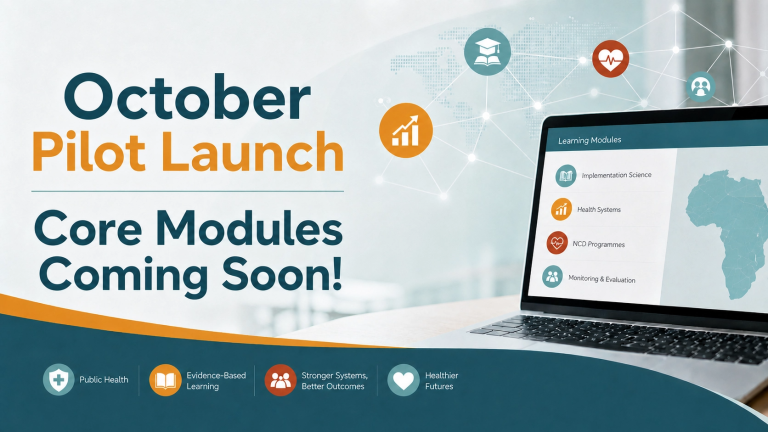
One of the most striking moments of the day came with the presentation of a conceptual digital learning platform — referred to as the E-hub — envisioned as the technological infrastructure through which all IS4NCDs courses will eventually be delivered and accessed.
The presenter was careful to note that what was shown was conceptual and that names and course titles used were placeholders. The intent was to demonstrate what is possible and to invite the consortium to shape the platform's design.
The proposed system is designed around several core functions: a structured course catalogue with personalised recommendations based on learner profiles and interests; competency tracking that allows learners and institutions to monitor progress against the IS4NCDs competency framework; mentorship matching and tracking; community of practice forums that facilitate peer support and collaboration; and live and asynchronous event management.
Critically, the platform is designed for institutional flexibility. It can be accessed as a standalone hub, integrated into existing university learning management systems such as Canvas, or made available as part of government human resource development plans — enabling national health departments to offer courses to all staff using verified institutional credentials.
The presentation drew enthusiastic responses. Participants were particularly excited about the platform's potential as a regional resource — one that could serve not only individual learners but entire government departments, and that could grow into a broader ecosystem connecting research evidence, data, and implementation science capacity across Southern Africa. The potential to incorporate AI-assisted learning pathways, matching learner profiles to the most relevant courses and resources based on verifiable contextual data, was raised as a future-facing ambition that the technical team is already exploring in related work.
On the practical question of sustainability, the consortium acknowledged that operating the platform will require a sustainable business model and likely a dedicated local technology partner. The team confirmed that subcontracting arrangements have already been explored, with quotations received from four providers and a preferred partner selected on the basis of their understanding of both academic institutional requirements and online platform development.
Transformative Learning and Challenge-Based Pedagogy
The afternoon sessions brought a more pedagogical focus, as participants engaged with the didactic principles that will animate all IS4NCDs modules: transformative learning and challenge-based learning (CBL).
The presenting facilitator walked the group through a foundational understanding of transformative learning — the kind of deep learning that changes a learner's perspective by prompting critical reflection on existing beliefs and assumptions. An interactive exercise using optical illusions illustrated how perspectives can shift in a moment, grounding the concept viscerally before the theoretical discussion began.
Four dimensions of transformative learning were presented as relevant to the consortium's work: what it is, what triggers it, what it looks like in practice, and how it can be embedded in module design. Participants were invited to bring these dimensions into their group work, considering how their specific module designs can create conditions for genuine perspective shifts.
Challenge-based learning was discussed as a complementary approach, structuring learning around real-world, complex NCD problems that require learners to apply knowledge, collaborate, and propose contextually grounded solutions. The relationship between CBL and transformative learning was described as mutually reinforcing: the challenge itself can serve as a trigger for transformative reflection.
Groups then broke into their respective module teams — core, intermediate, and advanced — to apply these concepts directly to their roadmap documents, identifying transformation points, linking learning outcomes more explicitly to the competency framework, and responding to a series of guiding questions about how to create safe spaces for reflection, integrate mentorship, and make transformative potential explicit in module instructions.
Reporting back from the groups revealed productive progress across all three levels. The core group noted that many transformative and CBL elements were already present in their roadmap and that the afternoon's work was largely one of alignment and articulation. The intermediate group proposed a set of structured "transformation points" — pre-reading, explicit group dialogue in the first week, peer-to-peer reflection, and ongoing mentorship — to make the transformation journey visible and deliberate for learners. The advanced group identified a distinct "big idea" for each of their three modules: equitable resource allocation in constrained settings for health economics; complexity for the context and multi-sectoral engagement module; and context for the theories, models, and frameworks module.
Looking Ahead
The day closed with thanks to participants and a look toward the remaining days of the meeting, which will focus on project management and timelines. The facilitator called on all groups to arrive ready to assign concrete dates to their module development milestones — recognising that the next major gathering is approximately a year away and that the pilots need to be delivered within the project's timeframe.
As participants gathered for a group photograph before their free evening, there was a palpable sense that the week had achieved something substantial: a shared vision not only of what the IS4NCDs training programme will look like, but of the infrastructure, pedagogy, and values that will carry it forward.