
Implementation Outcomes: The Programme Performance Map

Implementation Outcomes: The Programme Performance Map
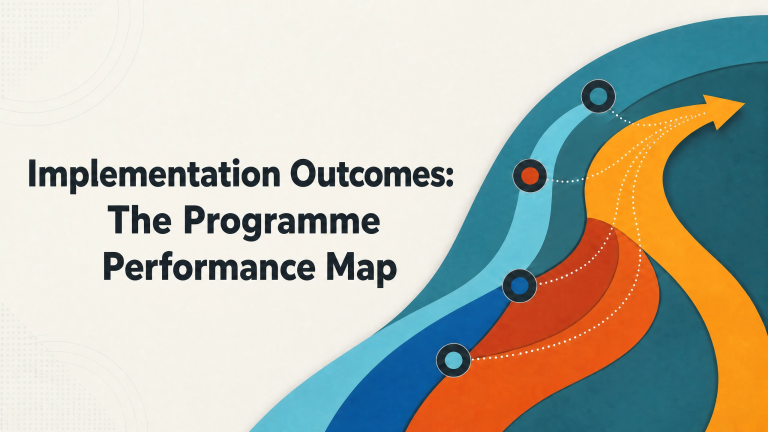
Implementation Outcomes: The Programme Performance Map

27 August 2026

A programme's performance is rarely a single verdict — it can succeed on some measures while falling short on others at the very same time, and knowing which is which matters enormously for anyone managing, funding, or shaping NCD programmes across Africa. In practice, this often means a programme can be well adopted and well liked by staff, yet still fail to reach enough patients or to keep running much beyond the pilot phase.

Take a district that rolls out a new diabetes self-management programme. Clinics signed on, and staff liked it — but only a third of eligible patients were ever actually enrolled, and by month eight, half the clinics had quietly stopped running it. So when someone asks, six months in, whether it worked, the honest answer is usually ‘sort of.’ It wasn't a failure: the programme was adopted, and it was acceptable to staff. What broke down was something more specific — not enough patients were reached, and the programme wasn't built to last past the pilot phase.

A Programme Can Succeed on Some Measures and Fail on Others

Success and failure are the wrong categories for diagnosing an NCD programme — implementation science replaces that single verdict with distinct, measurable pieces of programme performance, because the fix for "not enough patients were reached" is completely different from the fix for "staff did not like it" or "we ran out of money." This matters for health professionals and policymakers, not just researchers, since programmes get redesigned, defunded, or abandoned based on a single blanket statement — ‘it did not work’ — when the real story, and the real solution, is much more specific and far more fixable than that.

A widely used framework (Proctor's Implementation Outcomes) separates programme performance into these distinct dimensions:

  • Did people accept it?
  • Did they adopt it?
  • Was it a good fit for the setting and population?
  • Was it affordable?
  • Could it actually be delivered given real-world staffing and resources?
  • Was it delivered as designed?
  • Did it reach enough of the target population?
  • Critically, did it last?

Five Core Factors Shape Programme Success and Failure

Implementation outcomes act as the map that shows where each of five core factors fits — and which one to examine when something has gone wrong. Though we've covered these separately, they are really different pieces of the same picture:

  • Context is about the local conditions that shape whether a programme can succeed at all.
  • Frameworks are the structured tools used to assess that context and predict how it will affect an implementation.
  • Implementation strategies are the deliberate choices used to improve a specific outcome.
  • Fidelity is about whether a programme stayed true to its design as it was delivered.
  • De-implementation applies this same logic to stopping ineffective or harmful practices, not just starting new ones.

Building Capacity for NCD Programme Optimisation

Precise diagnostic tools, not guesswork, are what unlock the full potential of health initiatives and allow positive results to be scaled up. IS4NCDs is committed to training health professionals, programme managers, and policymakers across Southern Africa to make just that kind of determination — a skill that provides the technical precision needed to pinpoint exactly where an NCD programme can be optimised for success, offering the clear insights required to build upon existing organisational strengths.

Expressions of Interest will soon be accepted for this training, which launches with the Core Modules pilot in early October 2026, moving into the Intermediate Modules pilot in the third week of that month, before the Advanced Modules pilot follows in November. Each module carries a value of roughly ZAR 6,000, but during the pilot phase, funding covers this cost in full, so participants pay nothing.

The IS4NCDs project has received funding from the European Union's Erasmus+ programme under Grant Agreement no. 101179511
The IS4NCDs project has received funding from the European Union's Erasmus+ programme under Grant Agreement no. 101179511
De-Implementation: The Other Half of Implementation Science

De-Implementation: The Other Half of Implementation Science

De-Implementation: The Other Half of Implementation Science

25 August 2026

Health systems cannot successfully modernise care unless they master de-implementation, the distinct operational skill of actively withdrawing outdated clinical practices from circulation.

Clinical practice does not automatically stop just because evidence changes. Turning off an obsolete protocol requires dedicated ownership and specific strategies, which are entirely separate from the skills needed to adopt a new intervention.

A clear example is the persistence of sliding-scale insulin charts for stable, non-critical patients with type 2 diabetes. While current guidelines favour preventive basal-bolus regimens, sliding-scale dosing remains the default in many facilities. This continuation occurs not because staff are unaware of the updated guidance, but because health systems routinely fail to assign anyone to the job of taking the old charts out of use.

For professionals managing the growing burden of non-communicable diseases (NCDs), understanding how to systematically dismantle these entrenched, ineffective practices is the critical, missing half of implementation science.

Stopping a Practice Takes as Much Deliberate Effort as Starting One

De-implementation is the deliberate process of stopping a practice that is no longer effective, safe, or worth its cost. It is not simply what happens when implementation is absent; a practice already embedded in daily routine keeps running by default unless something specifically displaces it.

A handful of forces tend to keep low-value practices in place long after the evidence has moved on:

  • Clinical habit, built up over years of training and repetition
  • Fear of missing something without the old routine as a safety net
  • No designated owner for retiring outdated protocols
  • No clear replacement to slot into the gap the old practice leaves behind
  • Patient or family expectations built around the old routine continuing

The Same Outcomes Used to Judge New Programmes Apply to Retiring Old Ones

Implementation outcomes aren’t only useful for judging whether something new took hold. The same questions work in reverse for something being phased out:

  • Was stopping this practice acceptable to staff?
  • Was the replacement feasible to deliver with existing resources?
  • Did the change actually reach every part of the facility, or did the old chart quietly survive in one ward?

Treating de-implementation with the same rigour as implementation is what keeps a ‘we have updated the guidance’ memo from becoming the entire plan.

IS4NCDs Training Helps Teams Retire Low-Value Practices as Deliberately as Adopting New Ones

Training with IS4NCDs equips health professionals to approach decommissioning outdated clinical habits as a structured, intentional strategy. Rather than assuming old routines will simply vanish when new guidelines arrive, this initiative transforms de-implementation into a standard, teachable skill in the Southern African region. It shifts the focus from what to adopt to the far more complex task of managing how to stop.

IS4NCDs has scheduled the Core Modules pilot to launch in early October 2026, followed by the Intermediate Modules pilot in the third week of October, and the Advanced Modules pilot in November. Acceptance of Expressions of Interest is coming soon. The training modules, valued at approximately ZAR 6,000 per module, are fully funded — there is no cost to participants during the pilot phase.

The IS4NCDs project has received funding from the European Union's Erasmus+ programme under Grant Agreement no. 101179511
The IS4NCDs project has received funding from the European Union's Erasmus+ programme under Grant Agreement no. 101179511
Frameworks: The Bridge Between Context and Strategy

Frameworks: The Bridge Between Context and Strategy

Frameworks: The Bridge Between Context and Strategy

18 August 2026

A structured framework is essential for a successful protocol roll-out; without one, teams default to the loudest barrier in the room while quieter, decisive factors go unchecked. A programme team preparing to roll out a new hypertension treatment protocol can easily list dozens of things that might affect it—staff turnover, drug stock-outs, patient trust, referral delays, and funding cycles. However, a long list of maybes is not an actionable plan.

What turns that list into something usable is a framework: a structured set of categories that tells a team which factors are worth checking, in what order, and why. Without one, teams naturally fall back on whichever barrier is loudest in the room at the time—often staffing, because it is visible—while equally critical factors, like whether the protocol fits existing workflows, go ignored until the programme has already stalled.

Frameworks Turn a List of Maybes Into a Specific Checkable Plan

A framework doesn’t tell a team what its local barriers are — it tells them where to look. Instead of a vague sense that ‘context matters’, a team working through a framework is prompted to check specific, named domains: leadership buy-in, compatibility with existing workflows, communication channels, resource availability, and more, depending on which framework they are using.

That specificity is the entire value. ‘We should think about context’ produces a discussion. ‘Check whether this protocol is compatible with how staff already triage patients’ produces an answer.

Different Frameworks Answer Different Questions

Not every framework does the same job. Broadly, they fall into a few families:

  • Diagnostic frameworks, such as CFIR (Consolidated Framework for Implementation Research), map the context a programme is being dropped into, before and during roll-out.
  • Evaluative frameworks, such as RE-AIM (Reach, Effectiveness, Adoption, Implementation, and Maintenance), judge how a programme performed after the fact across all five of its core dimensions.
  • Process frameworks, such as NPT (Normalization Process Theory), explain how a new practice does or doesn’t become embedded into everyday routine work over time.
  • Integrated frameworks, such as i-PARIHS (integrated Promoting Action on Research Implementation in Health Services), combine the evidence, the context, and the facilitation effort needed to bridge that evidence with the local clinical context.

Picking the wrong type for the job is a common misstep — using an evaluative framework to plan a roll-out, for instance, tells a team how things went, not what to check beforehand.

Frameworks are the Bridge Between Reading Context and Choosing a Strategy

Context describes the local conditions a programme has to work within. Implementation strategies are the deliberate actions chosen to work with those conditions. A framework is what connects the two: it structures how a team reads the context in the first place, so the strategy that follows is a response to something specific rather than a guess.

The same logic that frameworks bring to diagnosis before roll-out also applies to diagnosing performance afterwards — which is exactly the territory implementation outcomes cover.

IS4NCDs Training Helps Teams Choose and Apply the Right Framework

IS4NCDs training is for people working within the health system across Southern Africa. The training programme builds the confidence to use these frameworks effectively, teaching participants to match the right tool to the correct stage of a project rather than simply relying on familiar options. The goal is to establish this as a standardised, teachable skill throughout the region.

IS4NCDs has scheduled the Core Modules pilot to launch in early October 2026, followed by the Intermediate Modules pilot in the third week of October, and the Advanced Modules pilot in November.

IS4NCDs will begin accepting Expressions of Interest soon. The training modules, valued at approximately ZAR 6,000 per module, are fully funded — there is no cost to participants during the pilot phase.

The IS4NCDs project has received funding from the European Union's Erasmus+ programme under Grant Agreement no. 101179511
The IS4NCDs project has received funding from the European Union's Erasmus+ programme under Grant Agreement no. 101179511

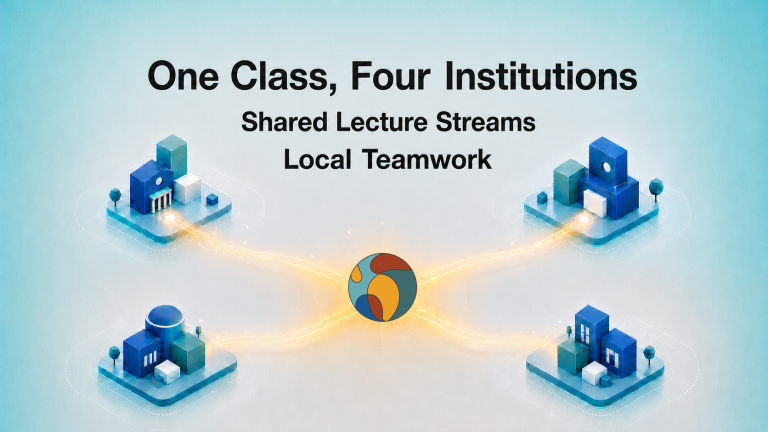
One Class, Four Institutions: Shared Lecture Streams and Local Teamwork

One Class, Four Institutions: Shared Lecture Streams and Local Teamwork

One Class, Four Institutions: Shared Lecture Streams and Local Teamwork

11 August 2026

When IS4NCDs set out to pilot its Core Modules, it faced a practical constraint common to multi-country training programmes: how to deliver the same rigorous, faculty-led training across four institutions without either repeating the same module four times or asking faculty to travel constantly between sites.

The answer is a hybrid delivery model built specifically for this challenge.

A Shared Lecture Stream, Delivered Locally

Beginning the first week of October 2026, the three Core Modules

  • Fundamentals of Implementation Science
  • NCD Epidemiology, Determinants of Health & Implementation
  • Designing, Monitoring & Evaluating Implementation Programs

will be piloted simultaneously at Copperbelt University, The University of Zambia, Stellenbosch University, and the University of the Witwatersrand.

One set of live lectures streams into all four classrooms at once. From there, participants at each site work through practical, challenge-based learning activities in person, facilitated locally by faculty at each institution. The result is a single, consistent curriculum delivered at scale, without sacrificing the in-person, team-based work on which implementation science training depends.

Why This Model, and Why Now

The approach reflects a requirement built into the project from the outset: each Core Module needs to be piloted at all four partner institutions, not just one. Streaming shared content once, rather than repeating it site by site, was the model that met that requirement most efficiently, whilst preserving space for locally facilitated, hands-on practice at every location.

What’s Ready Behind the Scenes, and What Comes Next

Accreditation and Continuing Professional Development approval processes are progressing at each partner institution, with several already at an advanced stage ahead of October. Ethics approval for the project’s evaluation protocol has already been secured through the Institute of Tropical Medicine Antwerp, giving partner institutions a shared foundation as they complete their own local reviews. A working group with representation from all seven consortium partners is also shaping the project’s regional learning eHub.

IS4NCDs will begin accepting Expressions of Interest soon. The Core Modules, scheduled for piloting in early October and valued at approximately ZAR 6,000 per module, are fully funded — there is no cost to participants during the pilot phase.

The IS4NCDs project has received funding from the European Union's Erasmus+ programme under Grant Agreement no. 101179511

The IS4NCDs project has received funding from the European Union's Erasmus+ programme under Grant Agreement no. 101179511

The Know-Do Gap: Why Good Evidence Alone Does Not Change What Happens in the Clinic

The Know-Do Gap: Why Good Evidence Alone Does Not Change What Happens in the Clinic

The Know-Do Gap: Why Good Evidence Alone Does Not Change What Happens in the Clinic

6 August 2026

A national hypertension guideline is published, endorsed and distributed to every facility in a province. The evidence behind it is not in question — it is drawn from large trials. Reviewed by experts and consistent with World Health Organization recommendations. Eighteen months later, an audit finds that barely a third of eligible patients are being managed according to it.

Nothing was wrong with the evidence. The guideline simply never closed the distance between what is known and what is done.

The Gap That Evidence Alone Cannot Close

Implementation science calls this the know-do gap — the persistent space between what research has established works and what actually happens in routine care. It is not a knowledge problem in the way it first appears. Most clinicians in the audit above were aware the guideline existed. Awareness was never the barrier.

The gap opens for reasons that have little to do with the strength of the evidence itself: a workflow that assumes staffing the guideline’s authors never accounted for, a supply chain that cannot sustain the recommended medication combination, or a patient population whose circumstances the original trial never captured.

Efficacy Is Not the Same Question as Implementation

Much of the confusion around the know-do gap comes from treating ‘does it work’ and ‘will it work here, delivered by this workforce, under the conditions’ as the same question. They are not. Efficacy research asks whether an intervention produces the intended effect under controlled or ideal conditions. Implementation research asks something else entirely: whether, and how, the same intervention can be delivered reliably under real, resource-variable conditions of routine care.

A guideline can be extremely well evidenced on the first question and still fail completely on the second — and in low- and middle- income health systems, where the gap between ideal and routine conditions is often widest, this distinction tends to matter more, not less.

Why the Gap Persists Longer in NCD Care

For a single-encounter intervention, the know-do gap is a one-off hurdle: either the intervention is delivered on that occasion or it is not. NCD management rarely works that way. A hypertension or diabetes protocol has to be delivered consistently, visit after visit, for years, across a health workforce that turns over and a supply chain that fluctuates. Every one of those repeat encounters is a fresh opportunity for the gap to reopen, even after it has apparently been closed.

Closing the Gap is a Distinct, Learnable Skill

Recognising that a know-do gap exists in one’s own setting is a reasonable starting point. Diagnosing why it exists in a specific facility or programme — separating a workflow mismatch from a resourcing shortfall because of a training deficit, and knowing which levers actually close each kind — is a distinct and considerably harder skill. Building that capability, calibrated to one’s position in the health system, is central to what the IS4NCDs training pathway is designed to do.

The IS4NCDs project has received funding from the European Union's Erasmus+ programme under Grant Agreement no. 101179511
The IS4NCDs project has received funding from the European Union's Erasmus+ programme under Grant Agreement no. 101179511

Context: The Variable That Decides NCD Programme Success

Context: The Variable That Decides NCD Programme Success

Context: The Variable That Decides NCD Programme Success

4 August 2026

When an NCD programme succeeds in one facility and stalls in another — despite using an identical protocol, identical training, and an identical evidence base — the cause is rarely a flaw in the intervention. It is almost always context: the surrounding conditions, inside and outside the facility, that a programme is dropped into. Context can be assessed systematically before rollout; when it isn't, the mismatch tends to surface only after the programme has already stalled.

Two Clinics, One Protocol, Two Different Results

A cervical cancer screen-and-treat programme launches across a region. In an urban clinic, uptake climbs steadily and holds. In a rural facility thirty kilometres away, running the identical protocol with the identical training, uptake barely moves before stalling out entirely.

Nothing about the intervention changed between the two sites. What differed was the context each was operating in.

Inner Setting and Outer Setting: The Two Layers That Make Up Context

Implementation science splits context into two critical layers:

  • The Inner Setting: What is happening inside the facility itself — leadership support, staffing levels, workflow, culture, and available resources.
  • The Outer Setting: What surrounds the facility — the policy environment, funding cycles, supply chains, referral networks, and community norms.

A programme can be well-designed and well-delivered and still fail purely because one or both of these layers was not accounted for. A well-staffed urban clinic with a reliable supply chain and an engaged facility lead offers a fundamentally different context than a single-nurse rural facility managing intermittent stock-outs — even when both are nominally running "the same programme."

NCD Care is Especially Exposed to Context, Because It Depends on It Holding Steady

Unlike a one-time intervention, NCD management is ongoing and heavily relies on long-term systemic stability:

  • Repeat patient visits over years rather than days
  • Continuous medication supply without interruption
  • Functioning referral pathways across different tiers of care
  • Consistent patient follow-up mechanisms

Each of these depends on context holding steady over a long period, which gives local conditions far more opportunity to make or break an NCD programme than they would a single-encounter intervention.

Structured Assessment, Not General Familiarity, is What Implementation Science Adds

Most health professionals already know that local conditions vary from one facility to the next — that observation alone isn't the insight. What implementation science adds is a structured way to assess which specific contextual factors are likely to matter, systematically, before rollout.

Frameworks used in the field — the Consolidated Framework for Implementation Research (CFIR) among them — break context down into specific, checkable domains:

  • Leadership engagement and strategic buy-in
  • Compatibility with existing clinical workflows
  • Communication networks and information flow
  • Resource availability and infrastructure capacity

That specificity is what turns a vague intuition into something a team can actually plan around.

Local Control Versus Escalation: Knowing Which Barriers are Actually Yours To Fix

Not every contextual barrier sits within local control. Part of working effectively with context is distinguishing what can be addressed locally from what needs to be escalated:

  • Local Control: Adjusting daily workflows, strengthening internal team communication, or identifying a local clinical champion.
  • System Escalation: Resolving national or regional supply chain issues, structural funding gaps, or broad policy limitations.

Directing effort accordingly ensures teams do not ignore system-level barriers or exhaust local capacity trying to fix something structural.

A Capability IS4NCDs Will Equip You With: Assessing Context Before Rollout, Not After

Understanding, in hindsight, why one clinic succeeded and another stalled is a useful starting point. Systematically assessing your own facility's context before rollout — and knowing which barriers are yours to fix locally versus which need to be escalated — is a distinct, learnable skill. It is a key capability that IS4NCDs training is designed to build, at a level suited to your position in the health system.

The IS4NCDs project has received funding from the European Union's Erasmus+ programme under Grant Agreement no. 101179511

The IS4NCDs project has received funding from the European Union's Erasmus+ programme under Grant Agreement no. 101179511